
Hospitality has always been built around experience.
A welcoming atmosphere, attentive service, memorable food and a strong sense of identity can turn a first-time visitor into a loyal customer. For decades, restaurants, cafés and other hospitality businesses built their reputations largely through what happened inside their physical locations.
Today, that experience often begins much earlier.
Before choosing where to eat, customers may search online, check a menu, look at photographs, read reviews, compare locations and try to make a reservation. They may discover a restaurant through social media, visit its website from a mobile phone and decide within minutes whether to continue or look somewhere else.
For food retailers and hospitality groups, the journey can be even more complex. Customers may want to order products online, buy gift vouchers, arrange delivery, find their nearest location or subscribe to receive news and offers.
The website has therefore evolved from a digital brochure into an important part of the customer experience.
A restaurant may provide exceptional service in person, but an outdated website, inaccessible menu or frustrating booking process can create a very different first impression.
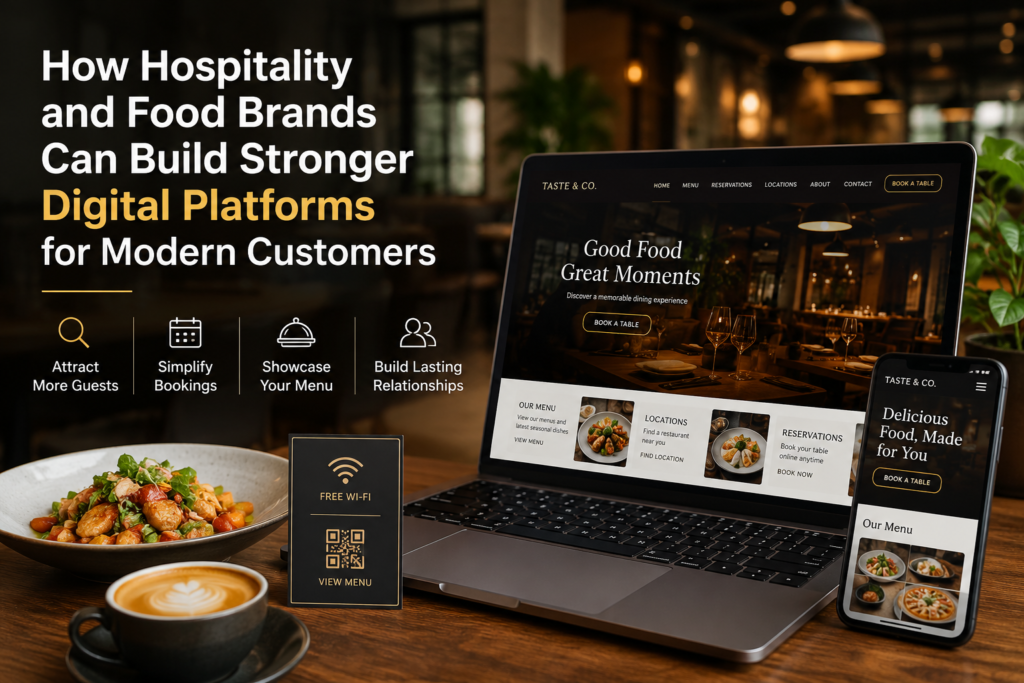
The challenge for modern hospitality businesses is not simply to have a website. It is to build a connected digital platform that makes it easier for customers to discover the brand, find useful information and take the next step.
The Customer Journey Often Starts Before Someone Arrives
Consider how someone might choose a restaurant today.
They may begin with a search for restaurants in a particular area.
They might open several websites and compare menus.
They may check whether vegetarian, vegan or other dietary options are available.
They may look at photographs to understand the atmosphere.
They might read customer reviews.
Finally, they may try to book a table.
All of this can happen before the restaurant has had any direct interaction with the customer.
This means digital touchpoints are already influencing expectations.
If the website loads quickly, provides useful information and makes booking simple, the experience creates confidence.
If the menu is impossible to read on a phone, opening hours appear inconsistent or the booking link does not work, uncertainty begins to develop.
Every digital interaction contributes to the customer’s perception of the business.
A Website Is Now Part of the Hospitality Experience
Hospitality businesses traditionally invest heavily in physical environments.
They consider interior design, lighting, furniture, music and presentation because these elements influence how customers feel.
The same thinking should increasingly apply online.
The website is another environment where customers interact with the brand.
Its design should communicate the character of the business.
A fine-dining restaurant may need a very different visual experience from a family café.
A street-food brand may want energy and personality.
A luxury hospitality group may prioritise sophisticated photography and elegant typography.
Design should therefore support positioning rather than simply follow trends.
More importantly, visual design should never make essential information difficult to access.
Customers usually visit hospitality websites with practical intentions.
They want to see the menu.
They want to know where the venue is.
They want to understand when it is open.
They may want to book.
The best websites combine brand experience with practical usability.
Different Hospitality Businesses Need Different Digital Experiences
There is no single website structure that works for every hospitality business.
A small independent café may need only a few pages, an accessible menu, contact information and strong local search visibility.
A restaurant may need online reservations and frequently updated menus.
A catering business may need enquiry forms, event information and detailed service pages.
A specialist food retailer may require a complete e-commerce platform.
A multi-location hospitality group may need individual location pages, centralised content management, recruitment functionality and integrations with several external systems.
The first step in any digital project should therefore be understanding the business model.
Technology should be selected around operational and customer needs rather than forcing the business to adapt to whatever functionality happens to be available.
Menu Design Is a Digital UX Problem Too
The menu is one of the most important pieces of content on a restaurant website.
Yet it is frequently one of the least user-friendly.
A common approach is to upload the same PDF that was designed for printing.
This may be convenient for the business, but it is not always convenient for customers.
On a mobile device, users may need to download the document, zoom repeatedly and move around the screen simply to read individual items.
A better digital menu should be easy to scan.
Categories should be clear.
Prices should be visible.
Dietary information should be presented consistently.
Customers should be able to move quickly between sections.
The menu is not simply content.
It is part of the user interface.
Mobile Users Need Information Fast
Hospitality websites often receive visits from people who are already out and deciding where to go.
These customers may be standing on a street, travelling or meeting friends.
They are unlikely to spend several minutes navigating a complicated website.
Important information should therefore be immediately accessible on mobile devices.
This includes:
- Opening hours
- Location
- Menu
- Booking options
- Contact details
Phone numbers should be easy to tap.
Maps should be accessible.
Buttons should be large enough to use comfortably.
Mobile experience should be considered from the beginning of the design process rather than treated as a smaller version of the desktop site.
Online Ordering Changes the Website’s Role
Once a business begins accepting orders online, the website becomes a transactional platform.
This changes customer expectations.
Customers need to understand what they are buying, how much it costs and when they will receive it.
The ordering process should be clear from beginning to end.
Unnecessary steps create friction.
Confusing delivery information creates uncertainty.
Poor mobile checkout can lead to abandoned purchases.
Businesses should therefore design online ordering around real customer behaviour.
The goal is to make completing an order feel natural.
When WooCommerce Makes Sense for Food and Hospitality Brands
Not every hospitality business needs a traditional online store, but many now have opportunities to sell beyond their physical premises.
Restaurants may sell gift vouchers.
Specialist food businesses may sell packaged products.
Cafés may offer branded merchandise.
Food producers may sell directly to consumers.
Some businesses may offer meal kits or seasonal products.
For organisations exploring these opportunities, professional woocommerce development services can help create an online store that combines product management, payments, delivery options and content within a flexible digital platform.
The important consideration is not simply whether the technology can process an order.
The platform should fit the way the business actually operates.
It should also be designed with performance, usability and future growth in mind.
E-Commerce Should Fit the Business, Not the Other Way Around
Technology can become unnecessarily complicated when businesses add functionality without a clear commercial reason.
A restaurant selling occasional gift vouchers does not necessarily need the same e-commerce architecture as a national food retailer managing thousands of products.
Before developing an online store, businesses should define what they actually want customers to do.
Is the goal to sell physical products?
Is it to sell vouchers?
Is local delivery required?
Will customers collect orders?
Does stock need to synchronise with another system?
Clear answers make it easier to build an appropriate solution.
Product Pages Need to Build Appetite and Confidence
Selling food online presents unique challenges.
Customers cannot smell, taste or physically examine the product.
The product page needs to provide enough information to create confidence.
High-quality photography is important, but information matters too.
Depending on the product, customers may need to know:
- Ingredients
- Allergen information
- Size or weight
- Storage requirements
- Preparation instructions
- Delivery conditions
Product descriptions should be informative without becoming unnecessarily complicated.
The goal is to answer the questions a customer might normally ask in person.
Booking Systems Should Reduce Friction
Online booking can be one of the most valuable functions on a restaurant website.
Customers can make reservations outside normal opening hours and receive immediate confirmation.
For the business, digital booking can reduce repetitive phone calls and improve reservation management.
However, the system needs to be reliable.
Customers should not have to create unnecessary accounts or navigate several disconnected pages.
The booking process should work well on mobile devices.
Confirmation should be clear.
If a customer is unsure whether the reservation has been completed, the technology has failed to provide reassurance.
Integrating Reservations, Orders and Customer Data
As hospitality businesses add digital tools, they can quickly accumulate separate systems.
One platform manages reservations.
Another handles online orders.
A third manages email marketing.
Customer information may exist in several places.
Integrations can help these systems work together.
For example, reservation data may support appropriate customer communications.
Online order information may connect with fulfilment systems.
However, integration should always be planned carefully.
Connecting every system simply because it is technically possible can create unnecessary complexity.
The objective should be to improve operations or customer experience.
Multi-Location Brands Need Better Website Architecture
A website becomes more complex when a hospitality brand expands to several locations.
Each venue may have different:
- Opening hours
- Menus
- Contact details
- Booking links
- Events
Customers should be able to find the correct information without confusion.
A strong multi-location structure usually provides a dedicated page for each venue.
These pages can also support local search visibility.
At the same time, the content management system should make updates efficient.
Staff should not need to edit dozens of unrelated pages every time central information changes.
Corporate Hospitality Websites Serve More Than Customers
As a hospitality business grows, its website begins serving additional audiences.
Customers remain important, but they are no longer the only visitors.
Potential employees may look for vacancies.
Suppliers may want company information.
Property owners may be interested in expansion plans.
Potential franchisees may be researching opportunities.
Business partners may need information about the organisation.
The website therefore needs to balance consumer-facing content with broader corporate communication.
When Corporate Website Development Becomes Necessary
Growing restaurant groups and hospitality organisations may eventually reach a point where a simple small-business website no longer supports their requirements.
Professional corporate website development can become relevant when the platform needs to manage multiple audiences, complex content structures, numerous locations, recruitment, integrations and consistent brand governance across a growing organisation.
The objective is not complexity for its own sake.
Good corporate architecture should actually make information easier to manage.
Different audiences should have clear routes through the website without being presented with irrelevant information.
Brand Consistency Matters Across Locations
Multi-location businesses face an interesting challenge.
Each venue may need its own personality and local relevance, while still belonging to the same overall brand.
The digital experience should reflect this balance.
Core design elements should remain consistent.
Brand language should feel connected.
At the same time, individual location pages can include unique photographs, local information and relevant content.
This helps customers recognise the wider brand while still understanding what makes each venue different.
Local SEO Can Drive Physical Visits
Search visibility has a direct relationship with physical hospitality businesses.
People frequently search for services based on location.
They may look for a restaurant nearby, a café in a particular town or a specific type of cuisine in their area.
Local SEO helps businesses appear during these moments of intent.
Important elements include accurate business information, strong location pages and consistent opening hours.
Customer reviews also contribute to online visibility and trust.
For multi-location businesses, each venue should be treated as a real destination rather than simply another address in a long list.
SEO Should Be Built Into the Website Structure
Search engine optimisation becomes much easier when considered during website planning.
Site architecture influences how both users and search engines discover content.
Hospitality businesses should consider:
- Logical URLs
- Location pages
- Internal linking
- Page speed
- Mobile usability
- Structured information
SEO should not compromise the customer experience.
The strongest approach improves both.
A clearly structured location page, for example, can help search engines understand the business while also giving customers the information they need.
Why PDF Menus Can Create Problems
PDF menus remain common because they are easy to upload.
However, convenience for the business does not always equal convenience for the customer.
Large files may load slowly.
Text can be difficult to read on mobile devices.
Users may need to zoom repeatedly.
Updates require replacing the entire document.
An HTML-based menu can often provide a better experience.
Content can adapt to different screen sizes.
Individual sections are easier to navigate.
Information can be updated directly.
There may still be reasons to provide a downloadable menu, but it does not necessarily need to be the primary experience.
Accessibility Matters in Hospitality Websites
Hospitality businesses serve diverse audiences.
Websites should therefore be designed to minimise unnecessary barriers.
Readable text, appropriate contrast and logical navigation benefit everyone.
Accessibility is also important when communicating practical information.
Customers should be able to find relevant details without relying entirely on visual cues.
Forms should be understandable.
Interactive elements should be clearly identifiable.
Accessibility should be part of design and development from the beginning rather than added as an afterthought.
Website Speed Influences Customer Decisions
Someone looking for somewhere to eat may compare several businesses within minutes.
A slow website immediately creates friction.
Large photographs are a common cause of performance problems on hospitality websites.
High-quality imagery is important, but images should be appropriately optimised.
Other performance problems may come from excessive scripts, poorly configured plugins or inefficient third-party integrations.
Speed should be monitored continuously as websites evolve.
Photography Should Support the Brand, Not Slow the Website
Food and hospitality are highly visual.
Photography can communicate atmosphere, quality and personality more quickly than paragraphs of text.
But more images do not automatically create a better website.
Photography should have a purpose.
Images can show:
- Food and drinks
- Interior spaces
- Outdoor areas
- Events
- The people behind the business
The strongest websites balance visual impact with technical performance.
Gift Cards Can Create an Additional Revenue Stream
Digital gift cards can provide hospitality businesses with another way to generate revenue.
They can be particularly useful around holidays and special occasions.
The purchasing experience should be straightforward.
Customers should understand how the voucher will be delivered and where it can be used.
For multi-location businesses, terms should clearly explain whether the voucher applies to one venue or the entire group.
Loyalty and Email Can Turn Visitors Into Repeat Customers
Acquiring a new customer often requires more effort than encouraging an existing customer to return.
Digital platforms can support repeat relationships.
Email can be used to communicate relevant news, new menus, events or seasonal offers.
Loyalty programmes may also encourage repeat visits when they provide genuine value.
Communication should remain relevant.
Sending constant promotions can reduce engagement rather than improve it.
Reviews and Social Proof Build Trust
Hospitality decisions are strongly influenced by the experiences of other customers.
Reviews can provide reassurance to someone considering a venue for the first time.
Businesses should monitor feedback and respond professionally where appropriate.
Negative reviews are inevitable for many established businesses.
The response can matter as much as the criticism itself.
A thoughtful response demonstrates that the company listens to customers and takes service seriously.
Social Media Should Not Replace the Website
Social media is extremely valuable for hospitality businesses.
Visual platforms can showcase food, atmosphere and events.
However, relying entirely on social media creates risks.
Platforms change.
Algorithms change.
Organic reach changes.
The website remains a digital environment the business controls.
Social media can create discovery.
The website should provide the reliable destination where customers can access accurate information and complete important actions.
Recruitment Is Often Forgotten
Hospitality businesses depend heavily on people.
Yet recruitment is often given very little attention on websites.
A careers section can help potential employees understand:
- Available roles
- Company culture
- Locations
- Benefits
- Application processes
For growing groups, the website can become an important recruitment channel.
This is another reason why larger hospitality platforms need to serve multiple audiences effectively.
Data Can Help Improve the Customer Journey
Analytics can reveal how customers interact with the website.
Useful questions include:
- Which menu pages receive the most visits?
- How many users click the booking button?
- Which locations attract the most search traffic?
- Where do customers abandon online orders?
- How does mobile behaviour differ from desktop?
The purpose of analytics should be to support decisions.
If customers repeatedly abandon a particular step, there may be unnecessary friction.
If a location page attracts significant traffic but few booking clicks, the call to action may need improvement.
Data becomes valuable when it leads to better experiences.
Security Matters When Websites Handle Payments and Customer Data
Hospitality websites increasingly handle transactions and personal information.
This creates responsibilities.
Platforms should be maintained regularly.
User access should be controlled.
Backups should be available.
Software should be updated appropriately.
Security should also extend to third-party integrations.
A website is only one part of the wider digital ecosystem.
Seven Digital Mistakes Hospitality Brands Should Avoid
1. Using Outdated PDF Menus as the Only Option
Menus should be easy to access and read, particularly on mobile devices.
2. Ignoring Mobile Users
Customers searching while travelling or already outside need fast access to essential information.
3. Making Booking Complicated
Every unnecessary step creates another opportunity for the customer to leave.
4. Publishing Inconsistent Information
Opening hours and location details should remain accurate across important digital channels.
5. Creating Weak Location Pages
Each venue should provide enough useful information to support both customers and local search visibility.
6. Overloading the Website With Heavy Images
Visual quality matters, but performance should not be sacrificed unnecessarily.
7. Building Disconnected Systems
Reservations, orders, marketing and customer information should be reviewed as parts of a wider digital ecosystem.
A Practical Digital Roadmap for Hospitality Brands
Step 1: Map Customer Journeys
Understand how different customers discover and interact with the business.
Step 2: Define Website Goals
Decide whether the priority is bookings, orders, visits, enquiries or a combination of objectives.
Step 3: Build the Content Structure
Organise menus, locations and services in a way that customers can understand.
Step 4: Integrate Bookings and Orders
Connect relevant systems where integration creates a smoother experience or operational benefit.
Step 5: Improve Mobile UX
Test important customer journeys on real mobile devices.
Step 6: Strengthen SEO
Improve technical foundations, local visibility and useful content.
Step 7: Track Performance
Measure actions that matter commercially rather than focusing only on total website traffic.
Step 8: Improve Continuously
Use customer behaviour and business feedback to guide future development.
When Is It Time to Rebuild?
Not every hospitality website needs a complete redesign.
Sometimes targeted improvements can solve the most important problems.
However, a rebuild may become appropriate when the underlying platform begins limiting the business.
Warning signs can include:
- Poor mobile usability
- Persistent performance problems
- Difficulty updating menus
- Broken integrations
- Confusing multi-location structures
- An outdated content management system
- New business requirements that the platform cannot support
The decision should be based on long-term business value rather than appearance alone.
The Best Hospitality Websites Connect Digital and Physical Experiences
The purpose of hospitality technology should ultimately be to support hospitality.
A website can help someone discover a restaurant.
A digital menu can help them decide what they want.
A booking system can reserve their table.
An e-commerce platform can allow them to purchase products or vouchers.
Local SEO can help them find the nearest location.
But the final objective is still a human experience.
Digital technology works best when it removes unnecessary barriers between customers and businesses.
Technology Should Make Hospitality Feel More Human, Not Less
Automation can create efficiency.
Booking confirmations can be sent automatically.
Orders can flow into fulfilment systems.
Routine communications can be managed digitally.
This should free staff to focus on the areas where human interaction creates the greatest value.
A customer with a complex question may still need to speak to someone.
A special event may require a personal conversation.
Technology should support these interactions rather than making the business inaccessible behind automated systems.
The Future of Hospitality Is Connected
The hospitality website of the future is unlikely to exist in isolation.
It will increasingly connect with booking technology, e-commerce, CRM systems, email marketing, loyalty programmes, analytics and local search platforms.
For customers, these systems should feel like one experience.
For businesses, they should create useful information and reduce unnecessary administration.
This requires planning.
Adding more technology does not automatically create a better business.
The strongest digital platforms are those where each component has a clear purpose.
For independent restaurants, that may mean a fast website with an excellent menu and simple booking.
For food retailers, it may mean integrating e-commerce with fulfilment and stock management.
For multi-location hospitality groups, it may mean creating a scalable platform capable of managing locations, recruitment, corporate information and customer journeys within one consistent digital ecosystem.
Whatever the size of the organisation, the principle remains the same.
Technology should make it easier for customers to interact with the business.
The website should reflect the quality of the real-world experience.
And every digital investment should connect to a genuine customer or commercial need.
Hospitality will always depend on people.
But as the journey between discovery and experience becomes increasingly digital, the businesses that connect technology with genuine hospitality will be better positioned to build lasting customer relationships.
Need Support With Your Next Digital Project?
Whether you are building a new hospitality website, launching an online store or creating a digital platform for a growing multi-location business, Prime Lion Digital can help.
From e-commerce and web development to UX, SEO and digital growth, the team helps businesses create scalable digital platforms that connect technology with real commercial goals.
Speak to the Prime Lion Digital team: +447488818286
